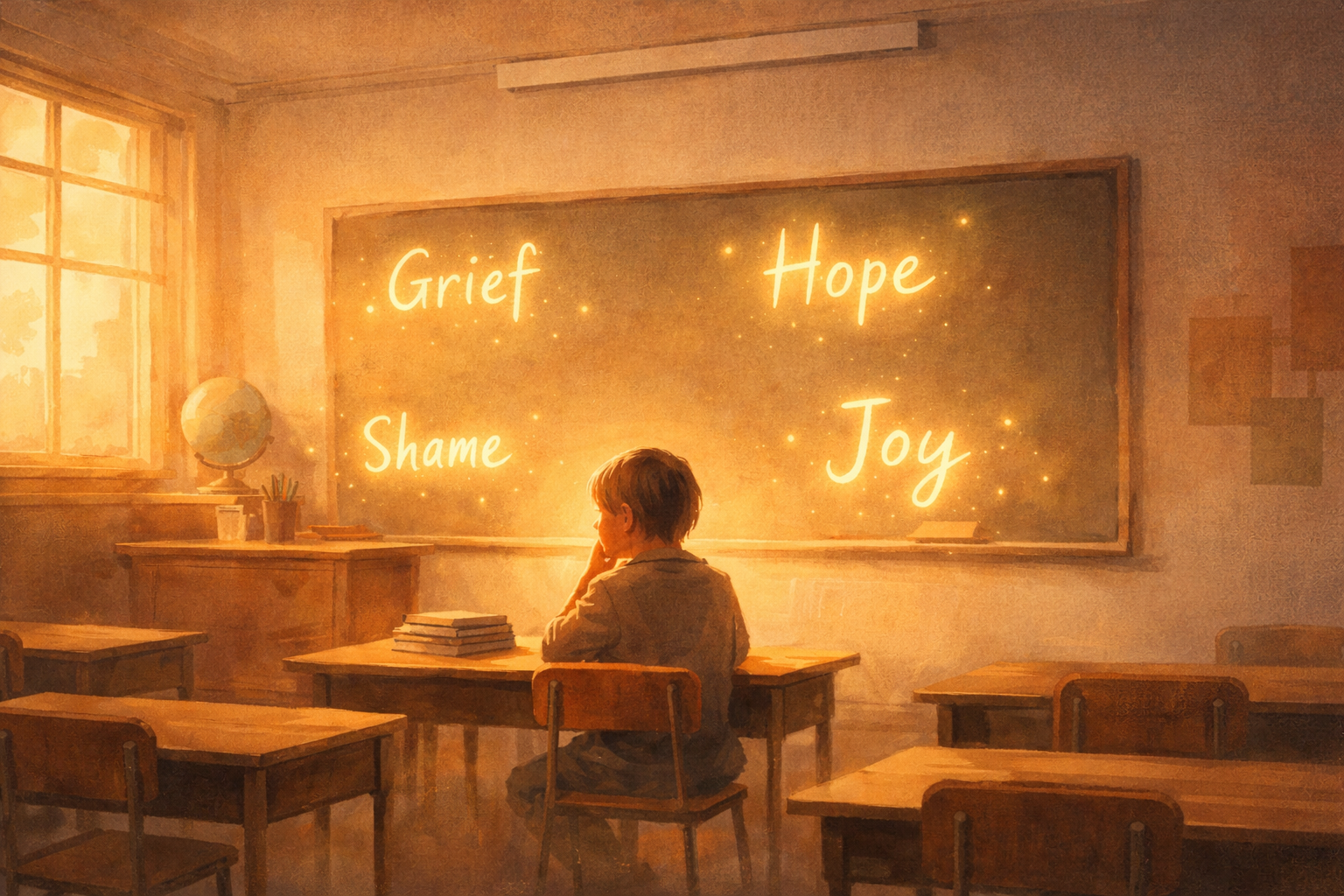
Emotional Literacy as a Life Skill
Why Feelings Deserve a Seat Beside Fractions and Phonics
We teach children how to solve for x. We show them how to conjugate verbs. We hand them rulers, calculators, and dictionaries as if these tools are passports to adulthood.
However, when it comes to emotions, we often offer little more than “calm down” and hope.
And yet, the ability to understand and name what we feel is not a soft luxury. On the contrary, it is a survival skill. Emotional literacy is as foundational as mathematics and as essential as language. In fact, without it, both logic and communication wobble.
So let’s talk about why.
What Is Emotional Literacy?
Emotional literacy is the ability to recognize, understand, label, and regulate emotions in ourselves and others.
In other words, it is fluency in the language of feelings.
Just as reading involves decoding symbols into meaning, emotional literacy involves decoding internal sensations into clarity. For example, instead of saying “I’m fine,” an emotionally literate person might say:
- “I’m overwhelmed.”
- “I’m disappointed.”
- “I feel left out.”
- “I’m anxious about being judged.”
The difference may seem subtle. Nevertheless, precision changes everything.
Because once you can name it, you can work with it.
Why Naming Emotions Changes the Brain
Neuroscience has repeatedly shown that labeling emotions reduces their intensity. When we put feelings into words, the brain shifts activity from the amygdala, which governs threat responses, to the prefrontal cortex, which manages reasoning and regulation.
Therefore, naming an emotion is not just poetic. It is neurological. Researchers studying emotional education, such as Marc Brackett in Permission to Feel, argue that naming emotions is not a luxury but a prerequisite for well-being.
For instance, saying “I feel rejected” instead of spiraling in silent hurt creates a small but powerful pause. During that pause, the nervous system begins to settle. Consequently, reactions become choices.
Without emotional literacy, however, feelings often leak out sideways. Sensitivity is often mislabeled before it is understood. Anger disguises sadness. Sarcasm hides insecurity. Silence conceals fear. As a result, relationships fracture over emotions that were never actually identified.
Emotional Illiteracy: The Hidden Curriculum We Inherit
Many adults grew up in homes where emotions were minimized, mocked, or misunderstood.
Perhaps anger was punished. Perhaps tears were labeled weakness. Perhaps fear was dismissed as overreacting.
As a consequence, entire generations learned to suppress rather than interpret.
Moreover, society often rewards emotional suppression. We praise the “low-maintenance” friend. We admire the “strong, silent” leader. We equate busyness with resilience. Meanwhile, the inner landscape goes uncharted.
Unfortunately, unexamined emotions do not disappear. Instead, they calcify. They show up as burnout, resentment, chronic stress, or unexplained anxiety.
Sometimes what we call restlessness is simply a hunger we were never taught to identify.
Thus, emotional literacy is not about becoming overly sensitive. Rather, it is about becoming accurate.
Why Emotional Literacy Should Be Taught Early

Children naturally feel deeply. However, without guidance, they lack vocabulary.
When a child throws a tantrum, we often see defiance. Yet underneath the behavior might be embarrassment, confusion, jealousy, or exhaustion. Therefore, teaching emotional words early gives children maps for experiences they already have.
Imagine if classrooms included daily emotional check-ins alongside attendance.
Imagine if “What are you feeling?” was asked as often as “Did you finish your homework?”
Over time, children would not only expand their vocabulary but also strengthen self-regulation. Additionally, they would learn empathy. After all, understanding your own emotions makes it easier to recognize someone else’s.
Consequently, emotional literacy becomes a social skill, not just a personal one. Many people find it helpful to use an emotion wheel to move beyond “good” or “bad” and identify more precise feelings.
Emotional Literacy in Adulthood
Although early education helps, emotional literacy is not reserved for childhood. Adults can learn it, too. In fact, many begin precisely because life forces them to.
For example:
- A breakup exposes attachment wounds.
- A promotion triggers impostor syndrome.
- Parenthood reveals unresolved patterns.
- Burnout highlights chronic self-neglect.
In these moments, emotional vocabulary becomes a lifeline.
Instead of saying “Everything is too much,” an adult might learn to say, “I feel unsupported,” or “I’m afraid of failing.” That shift, although small, creates direction. It moves us from chaos to clarity.
Furthermore, emotionally literate adults tend to communicate boundaries more effectively. They apologize with specificity. They disagree without exploding. They repair conflict rather than avoid it.
Therefore, emotional literacy quietly upgrades every relationship it touches.
The Ripple Effects on Mental Health
Emotional literacy also acts as preventative care.
When people can identify sadness early, they are more likely to seek support before it deepens into depression. Similarly, recognizing chronic stress allows for intervention before burnout solidifies.
In addition, naming shame reduces its power. Shame thrives in vagueness. Once articulated, however, it often softens.
This does not mean emotional literacy eliminates pain. Rather, it reduces confusion around pain. And clarity, in psychological terms, is stabilizing.
How to Practice Emotional Literacy Daily
The good news is that emotional literacy is trainable. It is not a personality trait. It is a skill.
Here are a few simple practices:
- Expand Your Emotional Vocabulary
Instead of defaulting to “good” or “bad,” explore nuance. Are you restless? Disappointed? Energized? Apprehensive? The more specific the word, the clearer the insight. - Pause Before Reacting
When something triggers you, ask: “What am I actually feeling?” Often, the first answer is surface-level. Therefore, dig one layer deeper. - Use “I Feel” Statements
Rather than accusing, describe your internal state. For instance, “I feel dismissed” communicates more effectively than “You never listen.” - Reflect at the End of the Day
Briefly review moments of emotional intensity. What happened? What did you feel? What did you need? Not all emotions arrive on time. Some show up long after the moment has passed.
Over time, these small habits compound. As a result, emotional literacy becomes second nature.

A Future Where Feelings Are Fundamental
Imagine a generation raised to articulate their inner world with confidence.
They would still learn algebra. They would still master grammar. However, alongside equations and essays, they would learn the architecture of their own minds.
Consequently, workplaces might experience fewer explosive conflicts. Relationships might contain more repair and less silent resentment. Leadership might integrate empathy with strategy.
In such a world, emotional literacy would not be seen as indulgent. Instead, it would be recognized as infrastructure.
Because ultimately, emotions drive decisions. They influence voting patterns, career choices, romantic attachments, and even health behaviors. Therefore, ignoring them is not rational. It is incomplete.
Final Thoughts
We would never tell a child that reading is optional. So why treat emotional fluency as accidental?
Understanding feelings does not make us fragile. On the contrary, it makes us deliberate.
When we can name what moves inside us, we gain leverage. When we understand our internal weather, we stop blaming the sky for every storm.
And perhaps most importantly, when emotional literacy becomes a shared skill, connection becomes less chaotic and more conscious.
Math teaches us how to measure the world.
Language teaches us how to describe it.
Emotional literacy teaches us how to live in it.






Leave a Reply