Fitting In Psychology: Why Trying to Belong Can Make You Feel Invisible
The Shape Everyone Learned to Wear

The Shape Everyone Learned to Wear
In the beginning, no one told us the rules.
They arrived quietly.
Not printed.
Not announced.
They floated in the air like pollen and somehow landed on all of us.
Smile here.
Laugh a little louder.
Lower your voice.
Don’t be strange.
And don’t be too quiet.
Above all, Don’t be too much.
We learned them the way fish learn water, by living inside it until it stops being visible.
—
There was a girl who noticed this early.
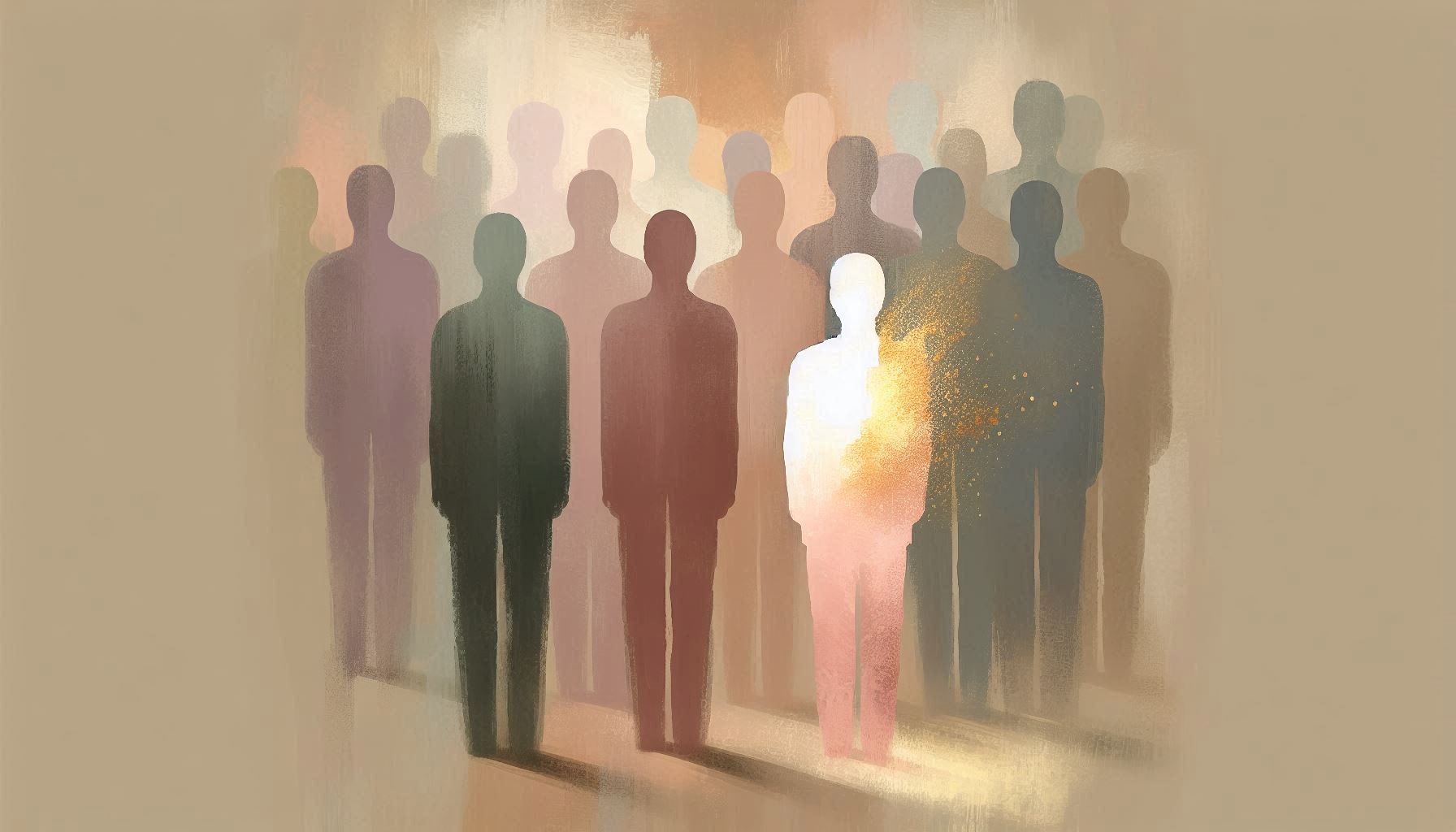
She realized that every room had a preferred shape.
Some rooms wanted sharp edges, opinions that cut clean and fast, while others wanted softness, agreeable nods, polite laughter.
Silence, in certain spaces, was shaped like obedience.
So she did what most people do when they want to belong.
She bent.
At first, it felt harmless.
A tilt of the head.
A swallowed sentence.
A laugh offered where confusion lived.
Each adjustment earned her something small and addictive.
Approval.
Ease.
A seat at the table.
Belonging is a powerful reward.
It tells the nervous system to relax.
It whispers, You’re safe here.
So she kept going.
—
Soon, she had many versions of herself, each neatly folded for different rooms.
With friends, she was louder.
At work, smaller.
With family, careful.
Online, polished into something almost unrecognizable.
She began to think of herself less as a person and more as a translation.
Who do they need me to be, and how fluently can I perform it?
No one ever asked her to disappear.
That’s the trick.
She volunteered.
—
When Fitting In Becomes Disappearing

Psychology has a name for this quiet vanishing.
Normative social influence.
The instinct to conform so we’re liked, accepted, not exiled from the group.
It’s ancient.
Once, belonging meant survival.
Rejection meant cold nights and empty hands.
The brain still remembers.
So when she felt the faint ache of being slightly different, her mind treated it like danger.
Smooth it out, it said.
Hide the odd angles.
Blend.
—
But something curious happened.
The more she fit in, the less she felt real.
Conversations began to feel scripted, like she was reading lines written by the room.
Laughter arrived on cue, but never lingered.
Compliments landed, but slid off without leaving warmth.
At night, alone, she felt strangely hollow.
Not sad exactly.
Just… absent.
She tried to explain it once.
“I feel invisible,” she said to a friend, half-joking.
The friend laughed. “But everyone likes you!”
Yes, she thought.
That’s the problem.
—
There is a quiet grief in being liked for a version of yourself that doesn’t exist.
Your nervous system never gets to rest.
It’s always scanning.
Adjusting.
Editing.
Am I too much here?
Not enough there?
Is this opinion safe?
Is that silence suspicious?
Fitting in is exhausting when it requires self-erasure.
—
The Quiet Shift from Blending to Being
One day, she stopped bending. Not dramatically.
No grand declaration.
Just small refusals.
A pause stretched where she would’ve filled it.
Gentle disagreement replaced automatic nodding.
The thing she liked replaced the thing that blended.
The reactions were immediate.
A raised eyebrow.
An awkward silence.
Someone said, “You’ve changed.”
She had.
She felt it in her chest, like muscles long unused finally waking up.
For a deeper psychological exploration of how fitting in shapes identity and self-worth, Susan Cain’s Quiet offers a thoughtful, research-backed perspective.
—
Slowly, Some people drifted away.
That hurt more than she expected, even though she knew why it happened.
When you stop fitting the shape, the room has to decide whether it can stretch.
Many rooms can’t.
They mistake difference for disruption.
Authenticity for arrogance.
Boundaries for distance.
So they close their doors quietly, politely, without explanation.
She mourned them anyway.

—
Belonging Is Not the Same as Being Liked
But something else happened too.
New people arrived.
Not in crowds.
In ones and twos.
They didn’t ask her to fold.
They didn’t flinch at her edges.
With them, silence felt full instead of tense.
Disagreement felt curious instead of dangerous.
She laughed without checking if it was the right moment.
Her body noticed first.
Her shoulders dropped.
Then, her breath slowed.
And finally, her thoughts stopped rehearsing.
Her nervous system said, “This is safe.”
—
Over time, Fitting in teaches you how to disappear.
Meanwhile, Belonging teaches you how to stay.
Psychology often talks about self-concept, the story we carry about who we are.
But that story can’t survive if it’s constantly rewritten by the crowd.
You can’t hear your own voice if you’re always harmonizing.
—
She still adjusts sometimes.
Everyone does.
We are social creatures, after all.
We soften, we adapt, we meet each other halfway.
But now she knows the difference between flexibility and self-betrayal.
One feels like movement.
The other feels like shrinking.
And she no longer mistakes the applause of the room for proof of worth.
—
If you’ve ever felt lonely in a room full of people,
If you’ve ever been praised and still felt unseen,
If you’ve ever wondered why fitting in feels like disappearing…
You’re not broken.
You’re just shaped differently than the room you’re in.
And somewhere, there is a space that doesn’t require you to bend to be allowed to exist.
Until then, let yourself take up a little more room.
Even if it’s quiet.
Not everyone will stay.
Especially then.
Because the people who recognize you
won’t need you to fit in.
They’ll need you to be.
You may find these relatable –
-

Redefining Masculinity: When Being a Man Means Being Yourself
Redefining Masculinity: When Being a Man Means Being Yourself A quiet story about a young man discovering that gentleness, curiosity, and authenticity belong inside masculinity, too. The Weight of Expectations Redefining masculinity rarely begins with loud rebellion. More often, it begins as a quiet discomfort with the roles handed to us. Arin felt that discomfort…
-

The Quiet Ease of Being Alone
The Quiet Ease of Being Alone Why comfort in solitude is not loneliness, but a deeper form of self-belonging There is a quiet kind of comfort that many people hesitate to admit. It appears in the small pauses between social obligations. It lives in afternoons spent with a book, a walk taken without conversation, or…





Leave a Reply