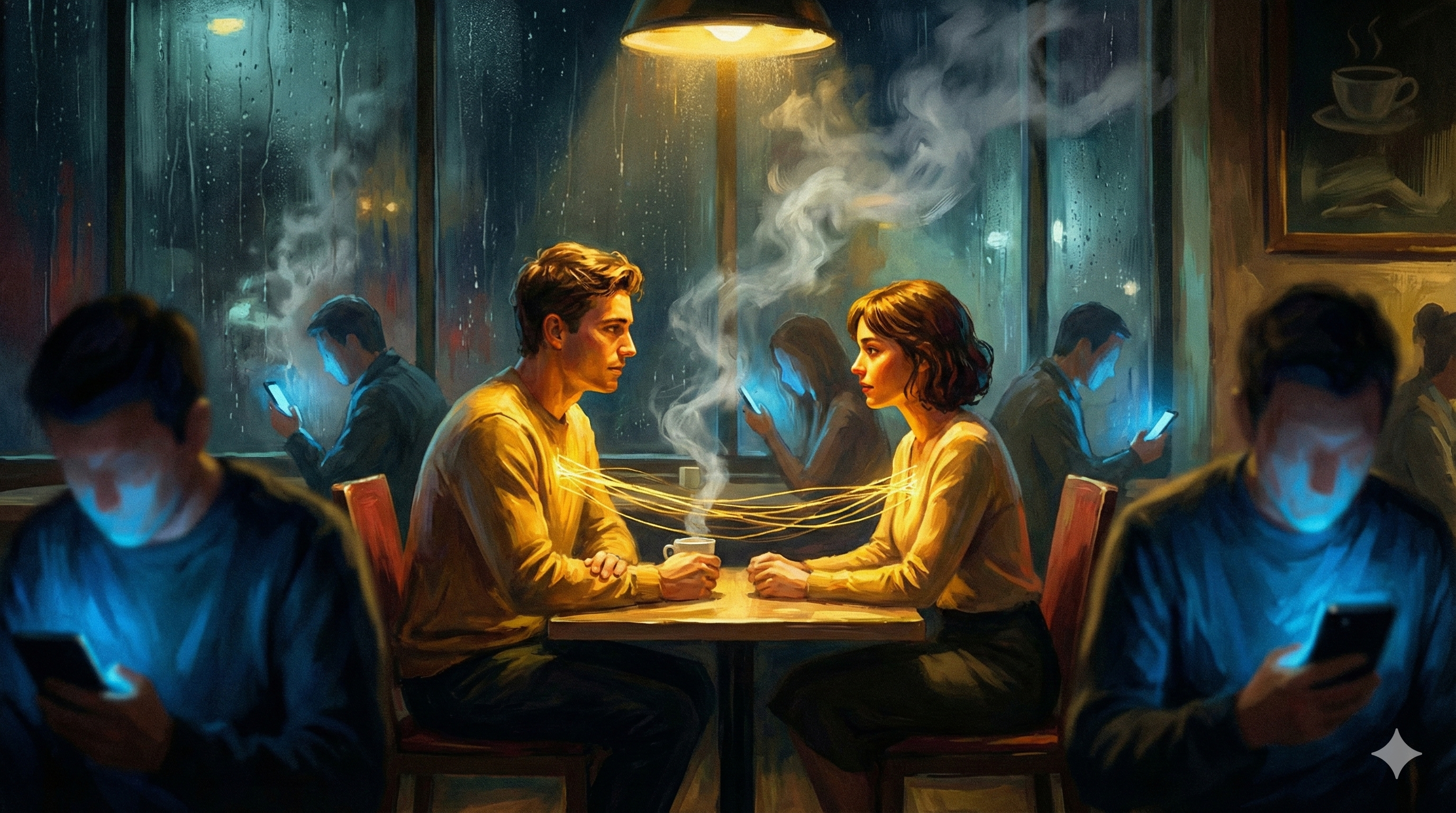
The Growing Need for Real Connections in a Filtered World
Why digital abundance is quietly intensifying our emotional hunger for depth

We can talk to anyone, anytime. We can send a message across oceans in seconds. We can react, comment, share, and scroll until the sky turns from indigo to gray.
And yet something inside us feels strangely untouched.
Although we are constantly in contact, many of us feel unseen. The world has become louder, faster, and more interactive. However, depth has not always kept pace with speed. As a result, the need for real connections is rising quietly beneath the noise.
When Contact Is Not Connection
At first glance, we seem socially abundant. Notifications bloom across our screens. Conversations overlap. Group chats never sleep.
However, contact alone does not regulate the nervous system. Real connection does.
Psychologically, being truly heard signals a sense of safety. When someone listens without rushing to fix or evaluate, the body softens. In contrast, surface-level exchanges often leave us slightly tense, as though we were performing rather than participating.
Therefore, even full calendars can coexist with emotional emptiness. This gap between interaction and intimacy is exactly why the need for real connections feels more urgent today.
This emotional void often resembles what I described in The Hunger That Doesn’t Have a Name, where longing exists without clear language.
The Exhaustion of Performing
Small talk has its place. It helps strangers orient to one another. Still, when most interactions stay polished and predictable, something deeper goes unfed.
Over time, constant self-curation becomes draining. We edit our feelings. We soften our opinions. We present manageable versions of ourselves.
Meanwhile, authenticity waits backstage.
Consequently, many people report feeling lonely in rooms full of others. The issue is not the number of people present. It is the absence of emotional risk. Beneath that absence, the need for real connections continues to grow.
A Cultural Turning Point
Interestingly, more people are beginning to name this gap.
Therapy language has entered everyday conversations. Words like boundaries, attachment, and emotional availability no longer live only in textbooks. At the same time, younger generations often prioritize vulnerability over perfection.
This shift does not mean we have mastered connection. Rather, it reveals collective fatigue with superficiality.
As a result, new questions are surfacing:
- Who feels safe?
- Where can I exhale?
- Which relationships allow imperfection?
These questions signal growth. They also reflect a deeper awareness of our psychological wiring.
Sometimes it mirrors the quiet transition I wrote about in The Grief of Becoming Better, where growth creates new emotional standards.
The Psychology Behind the Craving
From an attachment perspective, humans are wired for attuned relationships. Consistent emotional responsiveness teaches the nervous system that closeness equals safety. Without that foundation, connection can feel unpredictable or even threatening.
Nevertheless, the need for belonging does not disappear. It adapts.
Sometimes it shows up as hyper-independence. Sometimes it appears as overgiving. In other cases, it hides beneath busyness. Yet underneath these strategies, the longing remains intact.
Research consistently links meaningful relationships to resilience, improved mental health, and even longer lifespan. Thus, the growing need for real connections is not sentimental. It is biological.
For readers who want a deeper dive into attachment patterns and emotional bonding, Attached by Amir Levine and Rachel Heller offers a practical and research-backed foundation.
Why This Need Feels Stronger Now
Several forces are converging.
Digital culture amplifies comparison, which subtly erodes authenticity. Increased mobility disrupts long-term community bonds. Moreover, modern narratives often glorify self-sufficiency.
Independence is valuable. However, when autonomy becomes isolation, something fractures quietly.
Eventually, many adults find themselves socially surrounded yet emotionally solitary. That tension is difficult to ignore.
I explored this tension more deeply in Connection in an AI World: The Psychology We’re Yearning For, where technology amplifies both access and isolation.
What Real Connection Actually Requires
Depth rarely arrives dramatically. Instead, it accumulates in small moments.
Admitting you are not okay.
Staying present when someone else is not okay.
Tolerating disagreement without withdrawing.
Letting someone see you unpolished.
These actions feel vulnerable because they are. However, vulnerability is the doorway to intimacy.
Tools like a printed emotion wheel for emotional vocabulary can also help articulate feelings that otherwise remain blurred.
Paradoxically, boundaries strengthen connection. Saying no builds trust when it is honest. Showing up by choice deepens safety.
Real connection is less about intensity and more about consistency.
The growing need for real connections is not a passing trend. It is a recalibration.
We are discovering that visibility is not the same as being known. Applause is not the same as understanding. Interaction is not the same as intimacy.
And slowly, quietly, many of us are choosing depth over display.
That choice changes everything.






Leave a Reply